
Owaisi-Azad Alliance: Can Dalit-Muslim Consolidation Reshape Uttar Pradesh Politics?
As the AIMIM and Azad Samaj Party prepare to contest all 403 Assembly seats in 2027, their biggest challenge will be transforming demographic strength into a consolidated electoral force.
By Vishwas Dass
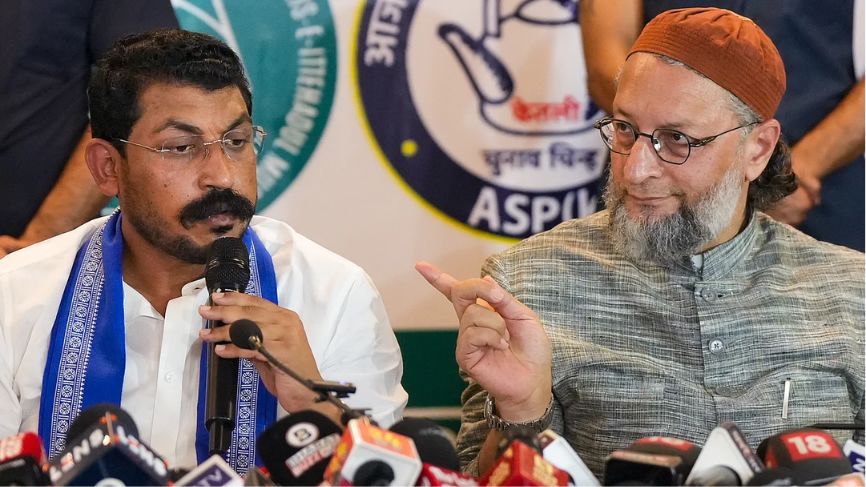
Two leaders, two distinct political constituencies and one ambitious electoral experiment. Asaduddin Owaisi, who commands considerable political influence in Hyderabad, and Chandrashekhar Azad, who has built his political identity around Dalit representation, are attempting to create a common political platform in Uttar Pradesh.
Their alliance, the Samajik Parivartan Morcha, raises a significant question ahead of the 2027 Assembly elections: Can a Dalit-Muslim political combination translate its demographic strength into meaningful electoral influence?
The Samajik Parivartan Morcha plans to contest all 403 Assembly seats in Uttar Pradesh, with Azad, the Lok Sabha MP from Nagina, projected as the alliance’s chief ministerial candidate. Owaisi has said that the alliance aims to prevent the BJP from returning to power for a third consecutive term.
The Demographic Advantage: A Political Combination of Nearly 40 Percent
The political arithmetic behind this alliance is significant. According to Census 2011 figures, Muslims constitute approximately 19.2 per cent of Uttar Pradesh’s population, while Scheduled Castes account for around 20.7 per cent. Together, these communities represent nearly 40 per cent of the state’s population.
The alliance reflects two distinct political ambitions. For Owaisi, it represents an opportunity to expand AIMIM’s political footprint beyond Telangana and challenge established political equations in Uttar Pradesh. For Azad, it offers a platform to take his Dalit-centred politics beyond his existing support base and establish a broader statewide political identity.
However, demographic strength alone does not guarantee electoral consolidation. Caste identities, local leadership, candidate selection, regional loyalties and competing political interests will all play a crucial role in determining whether these communities can come together under a common political banner.
Western Uttar Pradesh: Where Electoral Arithmetic Gets Interesting
The alliance is looking towards districts where Muslim and Scheduled Caste populations together constitute a substantial share of the electorate. Interestingly, several of these districts also overlap with regions where the Samajwadi Party has traditionally enjoyed considerable political support.
In Rampur, Muslims account for roughly 50.6 per cent of the district’s population, while Scheduled Castes constitute around 13.2 per cent. In Moradabad, the combined share of Muslims and Scheduled Castes exceeds 60 per cent.
Saharanpur presents another potential opportunity, with a sizeable Muslim population alongside a substantial Scheduled Caste presence. Bijnor, which includes Azad’s Nagina parliamentary constituency, could also emerge as a strategically important region for the alliance.
Amroha, Sambhal, Meerut and other parts of western Uttar Pradesh may offer further opportunities.
However, the real challenge will be identifying constituencies where these population shares can translate into a viable electoral coalition. The alliance cannot simply assume that communities with overlapping political interests will necessarily vote as unified blocs.
The Credibility Test: Can Owaisi and Azad Convert Influence into Votes?
AIMIM’s electoral record in Uttar Pradesh presents a formidable challenge. In the 2022 Assembly elections, the party contested several seats but failed to win any, securing approximately 0.49 per cent of the statewide vote. The Azad Samaj Party (Kanshi Ram) also failed to win a seat, polling approximately 0.13 per cent.
Owaisi’s stronger political base remains in Telangana, where AIMIM retained seven of the state’s 119 Assembly seats in the 2023 elections. Azad, meanwhile, has strengthened his political standing by winning the Nagina Lok Sabha constituency in 2024.
The alliance will therefore have to demonstrate that it can move beyond individual political influence and build a statewide organisational network capable of competing across Uttar Pradesh.
Its success will depend not just on the popularity of its leaders but also on grassroots mobilisation, booth-level management, credible candidates and sustained engagement with voters.
A Third Political Force or a Vote-Splitting Factor?
The emergence of the alliance also presents a political challenge for the Samajwadi Party (SP), which has built much of its opposition strategy around its PDA (Pichhda, Dalit, Alpsankhyak) formulation.
A separate Dalit-Muslim political platform could challenge the SP’s claim to represent these communities, particularly in western Uttar Pradesh, where both parties may seek to attract overlapping voter bases.
At the same time, the alliance could significantly influence electoral contests if it draws voters who might otherwise support other opposition parties. Such a shift could potentially benefit the BJP, especially in closely contested constituencies.
Whether the Samajik Parivartan Morcha emerges as a credible third political force or becomes a factor in splitting opposition votes will depend on its candidates, organisational strength and ability to build trust across communities.
The Opposition’s Dilemma: A New Equation That Could Change the 2027 Contest
An opinion piece in The Indian Express argues that a direct contest between the BJP and the SP-Congress alliance could otherwise encourage greater consolidation of anti-BJP votes. The BJP could potentially benefit if the new alliance attracts a section of Muslim and Dalit voters who might have otherwise supported the SP-Congress bloc.
In closely contested constituencies, even a modest shift in vote share could determine the final outcome. This means the alliance does not necessarily need to win a large number of seats to influence the overall electoral verdict.
Its political significance, therefore, could extend well beyond its own electoral performance.
Conclusion: Will Demographic Strength Translate into Political Power?
Ultimately, the success of the Samajik Parivartan Morcha will depend on whether Owaisi and Azad can move beyond demographic calculations and build a credible political coalition rooted in local leadership, organisational strength and shared aspirations.
The alliance has presented an ambitious political proposition, bringing together two influential leaders with distinct social and political constituencies. However, combining these constituencies into a cohesive electoral force will be far more challenging than announcing an alliance.
Its impact may extend beyond the seats it wins, potentially reshaping opposition unity, altering established political equations and influencing the BJP’s prospects in the 2027 Uttar Pradesh Assembly elections.
The real test will begin when political arithmetic meets the ballot box.